










































Regulatory Agency's official website link:https://www.fda.gov/medical-devices
Database link:https://www.accessdata.fda.gov/scripts/cdrh/cfdocs/cfRL/rl.cfm
1976 Food, Drug, and Cosmetic Act, Medical Device Amendment
1995 Safe Medical Device Act
Medical Device Regulatory Compilation:https://www.ecfr.gov/current/title-21/chapter-I/subchapter-H
Any medical device seeking to enter the U.S. market must first determine the classification and regulatory requirements for the product. The FDA makes final decisions on detailed device classifications based on recommendations from expert panels, and while regularly publishing classification results, also updates its regulatory codebase annually as needed.
English.
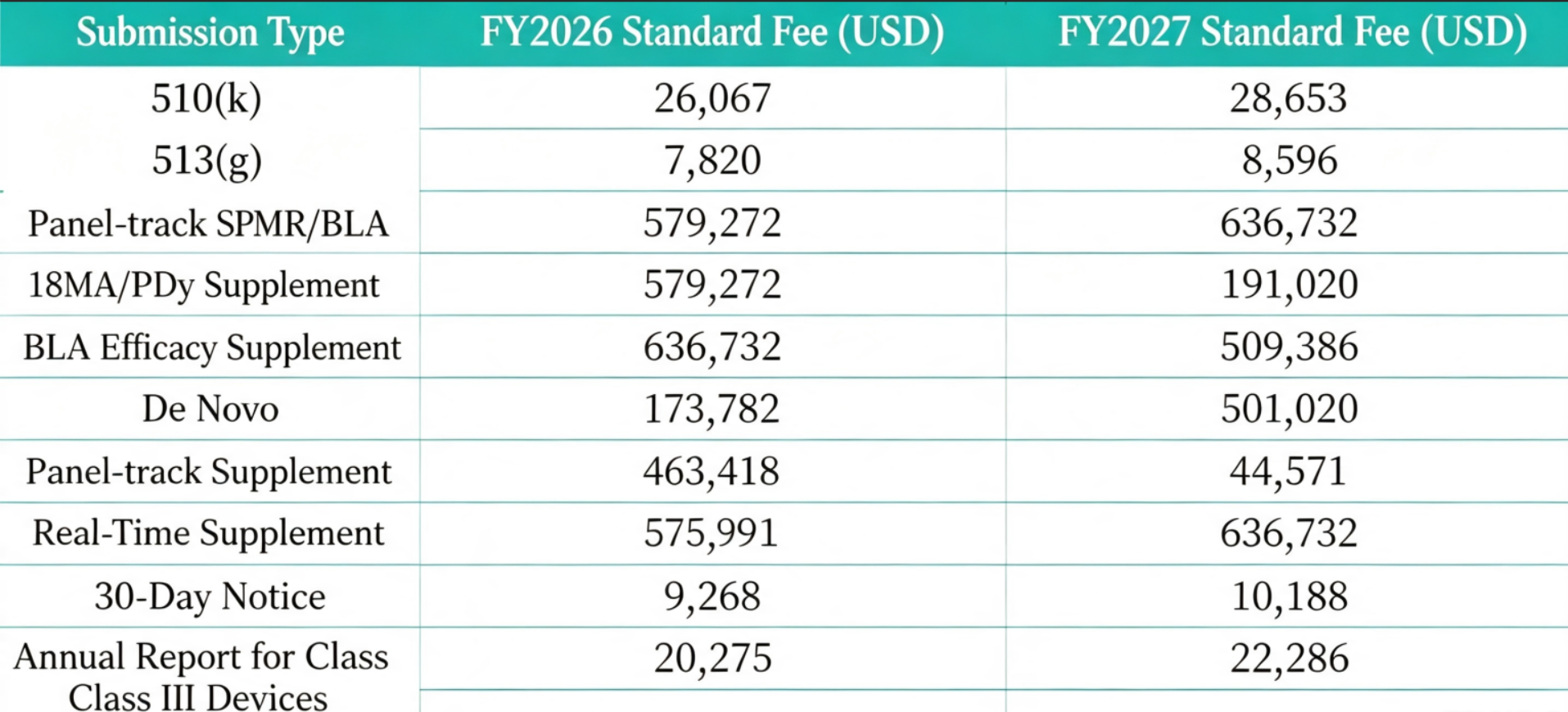
Time:FY2026:2025.10.1-2026.9.30;FY2027:2026.10.1-2027.9.30
A: The FDA allows some variation in technical parameters, but it must be demonstrated that these differences do not raise safety and efficacy concerns with the comparison device.
A: Additional information or additional testing: After a challenge from the FDA, the manufacturer is required to provide additional information or perform additional testing to demonstrate the safety and efficacy of the device. This may include providing additional clinical data, laboratory test results or other relevant evidence 12.
Modification of design or manufacturing process: If FDA determines that a device has significant differences in technical characteristics from a consistent device, the manufacturer may need to modify the design or manufacturing process to ensure that the device is consistent with the generic device in technical characteristics 1.
Resubmit the application: After adding the necessary information or performing additional tests, the manufacturer may resubmit the application. Ensure that all documentation is complete, accurate, and clearly shows the device's similarity to consistent devices 23
A: There are no significant changes to the labeling (e.g., intended use, indications, population, contraindications, contraindications, etc.) and "Distributed by ABC Firm" or "Manufactured for ABC Firm" (21 CFR 801.1) on the labeling, a new 510K application is not required.
A: U.S. Agent means a foreign manufacturer | brand | trader who has business in or in the United States is appointed as a registered agent for the purpose of FDA registration. U.S. Agent is a prerequisite for FDA registration.
U.S. agents act as the communication link between FDA and foreign manufacturers | brands | traders. They are not only required to submit application information at the time of registration, but are also responsible for emergency and routine communication. Their duties are as follows:
Document preparation and submission: Responsible for submitting documents required for product registration to FDA. Such as 510 (k) Advance market notification, PMA (Pre-Market Approval) application, alert notification, recall notification and other relevant documents.
Document maintenance and records: Maintain records of these documents for FDA audit and inspection to ensure that documents are available when required.
Information transfer and communication: Responsible for receiving and conveying all information, requirements and notices from FDA to manufacturers, submitting all necessary documents, notices and applications to FDA on behalf of manufacturers, and handling all correspondence and inquiries with FDA, including registration, license, application and other aspects of communication.
Problem solving assistance: Assist medical device manufacturers in resolving and responding to problems with the FDA in the event of product quality, safety, or regulatory issues. Documentation and information may be required to help FDA understand the situation and facilitate resolution of the issue.
[Note] : The FDA will contact the U.S. agent from time to time, and the U.S. agent must be able to answer the phone call from the FDA at any time. For the agent with untrue information, the FDA will require the factory to provide true information, otherwise it will impose penalties or even cancel the registration number of the factory.
