Philippines Medical Device Regulatory Authority

The Philippine Food and Drug Administration (PFDA) is responsible for approving and supervising the market access, distribution, and subsequent compliance monitoring of medical devices.
Regulatory Authority Official Website Link: https://www.fda.gov.ph/
Database Link:https://verification.fda.gov.ph/Medical_Device_CMDNlist.php
Regulatory Framework
[REPUBLIC ACT NO. 9711]
[The Rules and Regulations Implementing Republic Act No. 9711-the Food and Drug Administration Act of 2009]
Risk Classification of Medical Devices and IVD Products
① The original product classification in the Philippines has been harmonized according to Appendix 3 of the ASEAN Medical Device Directive (AMDD), classifying medical devices such as instruments, machines, in vitro reagents, software, and similar or related items for therapeutic or medical purposes into four classes: A, B, C, and D, ranging from low risk to high risk.
② Certificate of Medical Device Notification (CMDN) applies to Class A medical devices.
③ Certificate of Medical Device Registration (CMDR) applies to Class B, C, and D medical devices.
④ Certificate of Medical Device Listing (CMDL) refers to an authorization issued for medical devices intended for research, clinical trials, exhibition, donation, etc., not for sale.
In the Philippines, devices containing drugs are not considered medical devices.
IVDs (in vitro diagnostics) are classified separately from other medical devices, and are also divided into Class A, Class B, Class C, and Class D from low risk to high risk. In vitro diagnostic (IVD) medical devices are classified as registerable and non-registerable. Currently, only 9 types of IVD medical devices are considered registerable:
① HIV (antibodies and/or antigens), HBV (HBsAg and other markers), HCV (antibodies and/or antigens), and syphilis kits
② Single or combined drug screening kits/reagents for alternative drugs
③ Anti-A, anti-B, anti-D, anti-AB blood grouping sera
④ Anti-human globulin reagents
⑤ Potentiators such as enzymes, LISS, and albumin
⑥ Column agglutination tests for cross-matching and blood grouping
⑦ Pregnancy test kits/reagents
⑧ Leptospirosis test kits/reagents
⑨ Blood collection tubes
License Holder Requirements
The company that obtains the CMDN/CMDR/CPR or product approval license is also referred to as the product license holder. If the agreement between the manufacturer/supplier and the distributor (importer/exporter/wholesaler) is non-exclusive, multiple registrations using different distributor license holders for the same medical device are permitted in the Philippines.
Admission Prerequisites
① Both medical devices and IVDs require ISO 13485 or US FDA or Japan PMDA QMS audit report to demonstrate the quality system of the legal or actual manufacturing facility.
② Power of Attorney (The copy of the Power of Attorney shall be accompanied by an original notarized declaration from the legal manufacturer or product owner attesting to the authenticity and correctness of the authorization.)
③ Government-issued certificate certifying the manufacturer's status in terms of personnel and facility capability and reliability, quality system approval certificate, or ISO 13485 compliance certificate (The copy of the certificate shall be accompanied by a copy of a notarized declaration from the legal manufacturer or product owner attesting that the certificate is genuine and correct.)
④ Product registration certificate issued by the regulatory authority of the country of origin or a recognized notified body, or any equivalent document demonstrating the safety and effectiveness of the device (The copy of the certificate shall be accompanied by an original notarized declaration from the legal manufacturer or product owner attesting to the authenticity and correctness of the certificate.)
⑤ In addition to the above documents, a device description, certificate of conformity, declaration of conformity, shelf life statement, and clear, complete, color images of labels are also required.
⑥ For IVD products, technical documentation must also be submitted according to corresponding requirements based on different risk classes.
Language Requirements for Registration
English
Philippines LTO
LTO, or License to Operate, is a mandatory qualification for local medical device importers, distributors, traders, and manufacturers in the Philippines. It is used to ensure that enterprises legally operate medical devices, regulate market order, and guarantee product quality and safety. Obtaining an LTO requires meeting conditions such as enterprise registration compliance, personnel qualification training, quality management system, facilities and equipment, and involves processes including application preparation, submission, review and inspection, approval, and certificate issuance.
Registration Process, Timeline and Official Fees
1. Registration Pathway
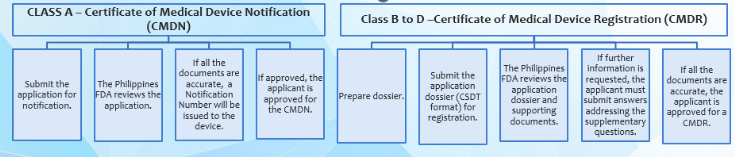
Class A (CMDN) Process: Prepare dossier → Submit notification application → Philippine FDA reviews application → Notification number issued if documents are correct
Class B-D (CMDR) Process: Prepare CSDT format dossier → Submit registration application → Philippine FDA reviews dossier and supporting documents → Submit response if additional information is required → CMDR approved if documents are correct
Simplified Process
Conditions:
- Applicable to Class B, Class C and Class D medical devices as specified under Administrative Order No. 2018-0002
- The device must have obtained product approval from any ASEAN Member State National Regulatory Authority (NRA) based on ASEAN Medical Device Directive - Common Submission Dossier Template (AMDD-CSDT) requirements
- The device is intended for importation, distribution and sale in the Philippines
Not applicable to in vitro diagnostic medical devices and reprocessed medical devices.
Review timeline: The turnaround time for the simplified process is 30 working days, counted from the date of receipt of proof of payment by the CDRRHR.
2. Registration Official Fees
| Device Classification | Total Official Initial Registration Fee |
|---|
| Class A Low Risk | 15,300 |
| Class B Medium Risk | 18,000 |
| Class C Medium‑to‑High Risk | 18,500 |
| Class D High‑Risk Implantable | 19,500 |
| Drug‑Device Combination Product | Separate special review; no fixed 90,000 rate bracket |
3. Registration Timeline
Class A: 4-12 weeks
Class B/C/D: Approximately 180 days