What is Apostille Certification?
Apostille Certification, also known as Hague Convention Certification, is a standardized authentication mechanism agreed among all Hague Convention member states to mutually recognize official public documents. Its core purpose is to verify the authenticity of documents so they can be legally accepted and circulated across all contracting parties of the Hague Convention.
Functions of Apostille Certification
Without a unified cross-border authentication standard, cross-border use of official documents would create massive administrative barriers due to divergent national legal systems. Apostille solves this problem by providing an internationally recognized anti-counterfeiting authentication format for cross-border public documents.
For example, Chinese citizens who need to submit personal identity or corporate paperwork overseas are required to obtain an Apostille. To date, 127 countries and regions have acceded to the Hague Convention Abolishing the Requirement of Legalisation for Foreign Public Documents. Documents intended for use within these territories must bear an Apostille. Compared with embassy consular legalization, Apostille is faster and has simpler formalities.
Key advantages of Apostille over consular certification: An Apostille issued by any member state is valid for all other Hague signatory countries. Consular legalization issued by one embassy is only recognized by that single target country and cannot be used elsewhere, while also requiring much longer processing time.
Note: Mainland China has no official Apostille issuing authority. If your documents originate from mainland China and require an Apostille, they must be processed in Hong Kong or Macao, both of which are Hague Convention members. Apostille is universally recognized by all signatory states; many non-member jurisdictions also accept Apostille documents voluntarily.
Authorities Authorized to Issue Apostille Certificates
Apostille issuance bodies vary by jurisdiction, typically national foreign ministries, supreme courts or state government agencies:
- United States: Issued by State Secretaries of State or the U.S. Department of State
- United Kingdom: Issued by the UK Foreign, Commonwealth & Development Office (FCDO)
- Australia: Issued by the Department of Foreign Affairs and Trade (DFAT)
- Hong Kong SAR: Issued by the High Court of Hong Kong
Core Nature of Apostille Certification
An Apostille only authenticates the signature and seal of the official who issued the original document, confirming the signatory’s identity is genuine and valid. A standard Apostille sticker with official seal and signature will be affixed to the document upon verification.
Crucially, an Apostille does not assess or validate the factual content of the underlying document—it solely verifies the authenticity of the issuing official’s signature.
Document Categories Eligible for Apostille
Personal Documents:Birth certificates, marriage certificates, divorce court judgments, green cards, passports, property deeds, etc.
Study Abroad Documents:Academic transcripts, degree certificates, etc.
Affidavit & Supporting Certificates:Single status certificates, police clearance certificates, death certificates, etc.
Commercial Corporate Documents:Company registration certificates, legal representative qualification documents, agreements, contracts, power of attorney, declarations, official certificates, appointment letters, trademark certificates, asset statements, financial credit certificates, director & shareholder records, articles of association, board meeting minutes, company name change documents, commercial invoices, certificates of origin, customs declarations, product certification, product brochures and other corporate paperwork.
List of Hague Convention Member States & Regions (as of January 2024, total 83)
Albania, Andorra, Argentina, Armenia, Australia, Austria, Azerbaijan, Belarus, Belgium, Bosnia and Herzegovina, Brazil, Bulgaria, Canada, Chile, Costa Rica, Croatia, Cyprus, Czech Republic, Denmark, Dominican Republic, Ecuador, El Salvador, Estonia, Finland, France, Georgia, Germany, Greece, Honduras, Hungary, Iceland, India, Ireland, Israel, Italy, Japan, Kazakhstan, Latvia, Lithuania, Luxembourg, Malta, Mauritius, Mexico, Monaco, Mongolia, Montenegro, Morocco, Namibia, Netherlands, New Zealand, Nicaragua, North Macedonia, Norway, Panama, Paraguay, Peru, Philippines, Poland, Portugal, Republic of Korea, Republic of Moldova, Romania, Russian Federation, Saudi Arabia, Serbia, Seychelles, Singapore, Slovakia, Slovenia, South Africa, Spain, Suriname, Sweden, Switzerland, Tunisia, Turkey, Ukraine, United Kingdom of Great Britain and Northern Ireland, United States, Uruguay, Uzbekistan, Venezuela (Bolivarian Republic)
Non-Hague Jurisdictions That Still Accept Apostille (as of January 2024, total 44)
Antigua and Barbuda, Bahamas, Bahrain, Bangladesh, Barbados, Belize, Botswana, Bolivia (Plurinational State), Brunei Darussalam, Burundi, Cape Verde, Colombia, Cook Islands, Dominica, Eswatini, Fiji, Grenada, Guatemala, Guyana, Indonesia, Jamaica, Kosovo, Kyrgyzstan, Lesotho, Liberia, Liechtenstein, Malawi, Marshall Islands, Niue, Oman, Palau, Rwanda, Saint Kitts and Nevis, Saint Lucia, Saint Vincent and the Grenadines, Samoa, San Marino, Sao Tome and Principe, Senegal, Seychelles, Tajikistan, Tonga, Trinidad and Tobago, Vanuatu
Similarities Between Apostille and Consular Legalization
- Both systems are designed to enable cross-border recognition of foreign official documents;
- Neither reviews the substantive content of documents—both only verify the authenticity of the issuing official’s signature and seal.
Differences Between Apostille and Consular Legalization
- Procedure: Apostille only requires certification by a foreign ministry or supreme court; consular legalization additionally requires embassy endorsement after domestic state authentication.
- Territorial Validity: An Apostille is recognized by all Hague member states; consular legalization is only valid in the single target country that issued the embassy stamp.
How to Apply for Apostille for Overseas Study, Immigration or Cross-Border Trade
Overseas authorities will request an Apostille for Chinese documents submitted in Hague member or Apostille-accepting countries. Example: A trading enterprise based in Shenzhen expanding business into Spain is required to submit Apostille-certified company registration certificates, certificates of origin and customs declarations. In such cases, documents can be notarized by a Hong Kong notary public, then submitted to the High Court of Hong Kong for Apostille endorsement.
Apostille vs Consular Legalization for Foreign Documents Used in Mainland China
All documents issued overseas (U.S., Canada, Australia, UK, France, etc.) intended for use in mainland China require consular legalization via Chinese overseas embassies/consulates; Apostille certification is not accepted for mainland China use. Documents submitted to Hong Kong or Macao may use either Apostille or consular legalization, subject to the specific requirements of local Hong Kong/Macao government authorities.
Can Wiselink Provide Apostille Agency Services?
Yes. Wiselink’s global headquarters is located in Sydney, Australia, with extensive international resource networks. We deliver cost-efficient, one-stop agency services covering medical device registration, pharmaceutical certification and full Apostille processing. Reach out to us for any inquiries about international regulatory documentation.
Australia is a signatory to the Hague Convention, meaning Australian documents bearing an Apostille are accepted by all Hague member and Apostille-recognizing territories, including Hong Kong, Macao, the U.S., UK, Spain and Germany.
Application Steps for Australian Apostille
- Confirm your documents meet DFAT Apostille requirements; translate non-English documents into English (translation is not required if the original file is in English).
- Complete an application form with your contact information and certification requirements, and attach copies of all documents for authentication.
- Mail the full application package to the Apostille department of Australia’s Department of Foreign Affairs and Trade (DFAT).
- Await official processing and receive your fully apostilled documents returned by post.
Important Note: Only documents previously certified by an Australian domestic notary/authority are eligible for DFAT Apostille. Domestic Australian authentication must be completed first if your paperwork lacks local certification, otherwise the Apostille application cannot proceed. Contact Wiselink for tailored guidance on document preparation and workflows.
Documents Required for Australian Apostille
Personal Documents
Marriage certificates, birth certificates, police clearance certificates, divorce decrees, passports, academic credentials, powers of attorney, kinship affidavits, single status certificates, death certificates, naturalization certificates, legal pleadings, etc.
Corporate Documents
Company registration certificates, articles of association, financial & tax records, commercial contracts, corporate POAs, appointment letters, product certificates, director & incumbent officer proof, legal representative documentation, board meeting minutes, board resolutions, financial credit certificates, certificates of good standing, etc.
Australian Apostille Processing Timelines
- Standard Service: 10–12 working days
- Express Rush Service: 4–6 working days
Australian Apostille Workflow
- MEDSAFE conducts preliminary document review to verify all materials are complete and accurate; applicants must supplement or revise incomplete submissions as requested.
Full Agency Procedures via Wiselink
- Consult Wiselink to clarify document intended use, submission deadline and total service fees.
- Confirm service terms, submit full supporting documents and sign formal service contract, then pay deposit.
- Wiselink submits the official Apostille application on your behalf.
- After certification is complete, we send scanned copies to you for confirmation.
- Upon your full payment of the remaining balance, the original apostilled documents are delivered to your address, completing the service.
Benefits for Chinese Enterprises Complying with Australian Hague (Apostille) Rules
- Legal Validation: Apostille certification verifies compliance with Australian regulatory standards for chemical products, boosting trust from local consumers and business partners.
- Market Expansion: Australian Hague/Apostille compliance acts as a competitive advantage to access Australia’s commercial market, the top-tier regulatory benchmark for chemical goods.
- Improved Product Quality: Mandatory compliance enforces strict internal quality control systems for chemical manufacturing, elevating product safety standards.
- Enhanced Environmental Governance: Australia enforces stringent sustainability and environmental protection rules for chemical production; meeting these standards optimizes manufacturing workflows and eco-friendly product design.
Certificate Template
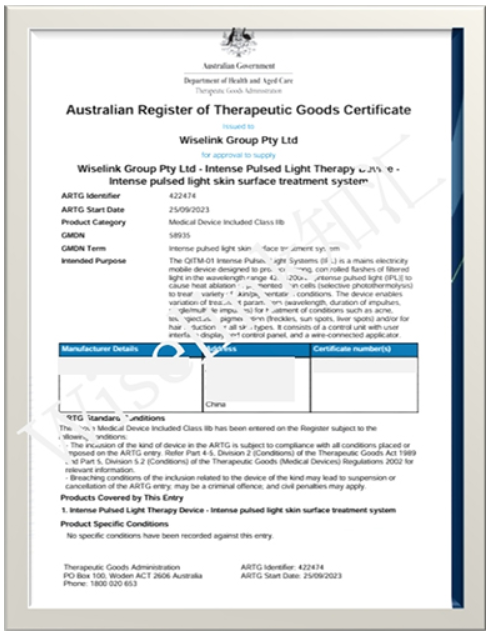
(Attached image: Sample Australian Register of Therapeutic Goods Certificate with official government header) Click the certificate image to view full details