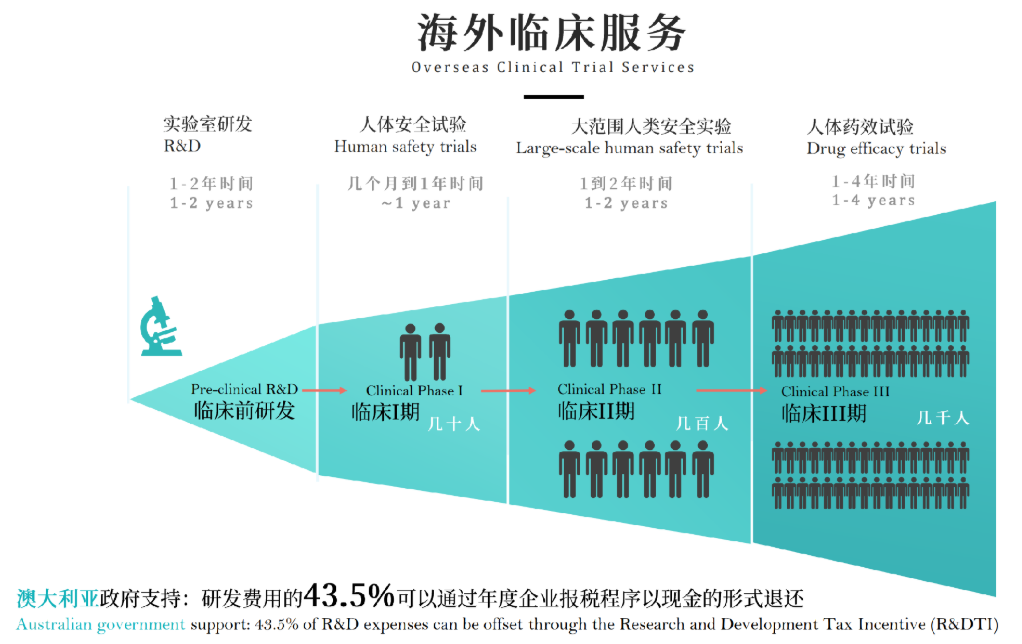
Overview & Market Position of Australia’s Clinical Trial Industry
Australia is globally recognized as one of the best jurisdictions worldwide to conduct clinical trials.
Australia boasts world-leading scientists, physicians and healthcare professionals. It features top-tier medical research and laboratory infrastructure, a stable socio-economic environment, multi-ethnic population demographics and a robust intellectual property (IP) framework—all key strengths of the country. Its highly efficient regulatory ecosystem includes streamlined clinical trial approval pathways, mature support service mechanisms, and globally competitive tax incentives for R&D investment, cementing Australia’s position as a prime destination for global clinical research.
Each year, pharmaceutical, biotech and medical device companies launch approximately 1,000 new clinical trials across Australia, with total investment reaching AUD 1 billion. The world’s top 10 pharmaceutical groups alone inject around AUD 200 million annually into Australian clinical trial programs.
Simplified administrative workflows enable rapid conversion of clinical study reports, delivering tangible benefits to global sponsors: trial data is reliable and readily acceptable for submission to other international regulatory authorities.
To further shorten trial startup timelines, boost patient recruitment and standardize clinical trial cost schedules, the Australian Government is rolling out a suite of reforms in collaboration with industry stakeholders. These policy revisions will strengthen Australia’s appeal as a clinical trial hub while upholding the strictest quality and ethical standards.
Core Advantages of Conducting Clinical Trials in Australia
- World-class medical research infrastructure and well-trained professional workforce
- Premium national healthcare system
- Attractive tax incentives for clinical trial and R&D expenditure
- Fast, pragmatic regulatory review pathways
- Clinical data generated in compliance with stringent international standards
- Comprehensive intellectual property protection regime
- Continuous improvement driven by government reforms and policy innovation
- Diverse multi-ethnic population with English as the native language
- Strategic geographic proximity to Asia
Core Value of Running Clinical Trials in Australia
1.Minimized Regulatory Burden
For over two decades, Australia’s Clinical Trial Notification (CTN) scheme has served as a global benchmark for reducing administrative compliance burdens for trial sponsors.
The majority of commercially sponsored clinical trials in Australia operate under the CTN framework. Investigators submit all trial-related documentation (including the full clinical protocol) directly to the institutional Human Research Ethics Committee (HREC) per sponsor requirements. The ethics committee independently assesses the scientific validity of the trial design, safety and efficacy of investigational drugs/devices, ethical acceptability of study procedures, and grants protocol approval.
The host medical institution conducts final local review of all trials undertaken on its premises. Under the CTN pathway, sponsors are only required to notify the Therapeutic Goods Administration (TGA)—Australia’s equivalent of the US FDA—once institutional ethics approval is secured. The TGA does not conduct substantive review of trial data, nor does it hold authority to audit or oversee trial operational management.
The CTN scheme eliminates redundant duplicate administrative work, saving sponsors substantial time and capital that can be reallocated to additional research projects and other core activities.
2.Competitive Tax Incentive Framework
Under Australia’s federal R&D Tax Incentive:
- Companies with annual aggregated turnover below AUD 20 million qualify for a 45% refundable tax offset;
- Entities with turnover exceeding AUD 20 million receive a 40% non-refundable tax offset on all eligible R&D expenditures.
The incentive scheme is intentionally structured to enable predictable, accessible tax benefits for qualifying enterprises.
Unlike comparable programs in other jurisdictions, Australia’s policy imposes no requirement for companies to demonstrate year-on-year growth in R&D spending to claim benefits, nor does it mandate that IP arising from eligible R&D projects be retained within Australian territory. The policy prioritizes the intrinsic value of the R&D process itself, regardless of where resulting IP is ultimately held.
Crucially, the R&D Tax Incentive delivers globally competitive benefits for both domestic and foreign entities conducting research within Australia. A recent report by multinational accounting firm KPMG ranks Australia among the world’s top 10 most attractive destinations for R&D investment.
3.Robust Protection of Valuable Intellectual Property
Australia maintains one of the world’s most secure and stable IP systems. According to the International Property Rights Index, Australia ranks 11th out of 142 surveyed nations and regions for IP security, on par with Germany, Japan and the United Kingdom, and outperforming jurisdictions including Belgium, France, Taiwan (China) and Israel.
Key strengths of Australia’s IP framework are outlined below:
3.1 Broad Eligibility for Patent Protection
Patent protection covers all therapeutic inventions, including novel active pharmaceutical ingredients, innovative formulations, natural therapeutic extracts and original treatment methodologies.
3.2 Patent Term Extensions
Consistent with the WTO Agreement on Trade-Related Aspects of Intellectual Property Rights (TRIPS), standard patents grant a 20-year term of protection in Australia. Since 1999, patentees of pharmaceutical products have been eligible for Patent Term Extensions (PTEs) to offset delays incurred during regulatory registration review. This provision allows patentees to extend patent validity by up to five years, delivering a maximum effective protected term of 15 years from the date the pharmaceutical product is first listed on the Australian Register of Therapeutic Goods (ARTG).
3.3 Data Exclusivity
Beyond patent protection, Australia offers five years of data exclusivity for new medicinal products. This legal provision prohibits competitors from referencing proprietary safety and efficacy data for five years following the first listing of a new drug or vaccine on the ARTG.
3.4 Innovation Patents
Innovation patents carry a maximum eight-year term, contrasting with the 20-year term of standard patents. They are designed to protect inventions that do not meet the inventive threshold required for full standard patents. Innovation patents provide a faster, cost-effective route to secure IP rights for novel medical devices, pharmaceutical formulations, delivery systems and manufacturing processes.
Service Strengths of Wiselink AU
- Wiselink AU is a nationwide investment and incubation institution focused on technology and healthcare industries
- Full-spectrum services including technical R&D collaboration, clinical trial result commercialization, pharmaceutical compliance training, and investment & financing advisory
- Long-standing close partnerships with leading Australian research institutes, clinical trial centers, pharmaceutical enterprises, investment bodies and relevant government authorities
- End-to-end resource integration and cross-border technical cooperation channels supported by our global business network