







































The US drug regulatory authority

1736476745199418.png

The Food and Drug Administration (FDA) of the United States is a federal government agency directly under the Department of Health and Human Services. Its responsibilities include the approval of drugs for market entry and post-market supervision.

Regulatory Agency's official website link:https://www.fda.gov/drugs/forms-submission-requirements/drug-master-files-dmfs

Database link: https://www.fda.gov/drugs/drug-master-files-dmfs/list-of-drug-master-files-dmfs

What is DMF?

When drugs are imported into the US market, they must comply with strict regulations and control policies, including the import management of OTC, prescription drugs, raw materials, and packaging materials. Generally speaking, OTC and prescription drugs usually undergo FDA NDC registration and ANDA registration, while raw materials, excipients, and packaging materials usually undergo DMF (Drug Master File) registration.
DMF (Drug Master File, the non-public document for drugs) is a type of registration file required by the US FDA, used to submit relevant data such as drugs, raw materials, packaging materials, additives, formulas and processes.
DMF is typically submitted by manufacturers or suppliers of pharmaceutical raw materials, packaging, and additives to the FDA, and is used to support the application for new drug approval (NDA), generic drug application (ANDA), or other related applications.

Main Guidelines

DMF Guidance
FDA, 2018, Comprehensive Table of Contents Headings and Hierarchy.
FDA, 2018, eCTD Technical Conformance Guide.
FDA, 2017, MAPP 5040.1 Product Quality Microbiology Information in the Common Technical Document—Quality (CTD-Q).
FDA, 2017, Technical Conformance Guide for Shared System REMS Drug Master File Submissions.
FDA, 2017, Transmitting Electronic Submissions Using eCTD Specifications.

The five types of DMF

a. Type I: Manufacturing Site, Facilities, Operating Procedures, and Personnel
b. Type II: Drug Substance, Drug Substance Intermediate, and Material Used in Their Preparation, or Drug Product
c. Type III: Packaging Material
d. Type IV: Excipient, Colorant, Flavor, Essence, or Material Used in Their Preparation
e. Type V: FDA Accepted Reference Information
The DMF holder (DMF Holder) can authorize one or more applicants to index the same DMF, without disclosing any confidential information contained in the DMF to the applicants; the submission of the DMF is entirely at the discretion of the holder, and there is no mandatory requirement for the submission of DMFs as per the regulations.

Registration Language

English.

Registration process, duration and official fees

1. Registration Flowchart
The FDA Drug Master File (DMF) registration process begins with DMF document preparation, followed by pre-application for a DMF number and submission to the FDA via the ESG portal. The agency first conducts an administrative review; if administrative deficiencies are identified, the applicant must submit a response to address them. After passing administrative review, the process follows two paths based on DMF type: for API Type II DMFs intended to support ANDAs, the FDA conducts a Completeness Assessment (CA); if deficiencies are found, the applicant responds to the CA deficiencies. If the CA is accepted, the DMF is listed on the CA inventory, and once referenced by an NADA, it proceeds to technical review, where any identified deficiencies require a response before the FDA issues the First Adequate Letter. For other DMF types or those referenced by INDs, NDAs, or BLAs, the FDA directly conducts a technical review; if deficiencies are found, the applicant responds, and once resolved, the DMF is deemed suitable for its intended use.
2. Relevant costs and duration

The user fees for Type II API DMF reviews vary by U.S. fiscal year (October 1 to September 30 of the following year). 
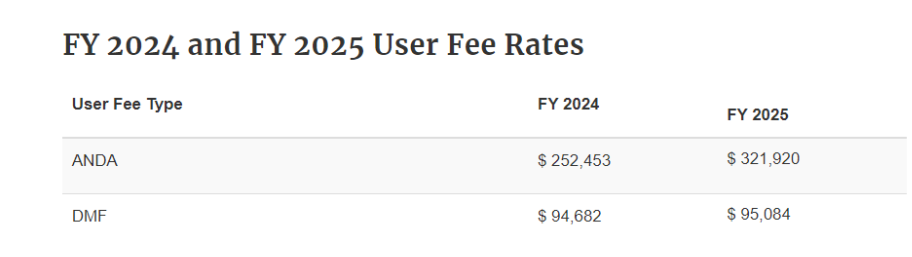
image.png

In terms of review timelines, the administrative review is generally completed within 2–3 weeks after submission. For the Completeness Assessment (CA) review, API Type II DMFs require payment of GDUFA fees before the CA review can proceed, which typically takes about 60 days.

Brief Description of DMF Submission Materials

1. Administrative Information (Module 1)
Includes information about the DMF holder, agent (if any), manufacturer, and prohibited certifications.
The holder is required to provide the name and address; the agent needs to provide detailed contact information and responsibilities; the manufacturer is required to provide the name, address and contact person information. At the same time, an LOA must be submitted, clearly stating the authorizing party and the authorized content. The list of the authorizing party should also be provided and updated in a timely manner.
2. Quality Overview (Module 2)
Summarize the relevant sections of Module 3 (and Module 4 and 5 if applicable).
3. Production and Quality Control Information (Module 3)
Organize the information by DMF type, including production processes, quality standards, method validation for analysis, stability studies, etc. The specific content varies depending on the type of DMF.
4. Non-clinical Evaluation Information (Module 4)
If the DMF contains non-clinical evaluations, such as non-clinical evaluations of excipients in Type IV DMF, impurities in Type II DMF, or non-clinical evaluations in Type V DMF, then it must be submitted in this module.
5. Clinical Information (Module 5)
Submit only when the Type V DMF contains clinical information.
6. Other Information
Documents related to the DMF, such as labels and REMS (Risk Evaluation and Mitigation Strategies) related files, will be provided in the corresponding modules based on the type of DMF and specific circumstances. For example, DMFs related to drug substances and drug products need to provide copies of shipping labels in the Labeling section, and relevant files related to REMS will be provided in the REMS section when available.

DMF amendments

1. Any changes, additions or deletions to the DMF (including the authorization letter LOA) must be submitted to the FDA. The submission should include a cover letter and updated administrative and technical information (if applicable).
2. Name change, acquisition or ownership transfer: When the name of the DMF holder changes (such as due to name change, acquisition or transfer of ownership), the FDA must be notified in the administrative amendment. For agency changes, an agency appointment letter must also be submitted. In the case of ownership transfer, the original holder and the new holder need to separately submit a transfer notification and an acceptance notification, and sign a commitment statement.

DMF Annual Report

The DMF annual report is mainly used to assure the timeliness of the DMF to the FDA and covers various aspects. The summary is as follows:
1. Submission Requirements and Numbering Rules
① The annual report should not report changes in DMF. If there are both corrections and the annual report is required, separate submissions should be made and use different eCTD sequence numbers.
2. Content Composition
① It should include a cover letter. FDA recommends using the template on the CDER's DMF webpage. The cover letter should specify that the submission type is an annual report and include all necessary information.
② A commitment statement signed by the DMF holder is required, indicating that the DMF is the latest version and that the holder will abide by the statements therein. The statement can be included in Section 1.2 of the eCTD or submitted along with the annual report.
③ Include appropriate administrative information, such as the DMF holder, agent (if any), manufacturer, etc., similar to the administrative information requirements in the initial submission.
④ List the amendment dates since the last annual report (or the original submission date), which will help the FDA understand the update history of the DMF.
⑤ Provide a list of the authorizing parties, including the information of all parties currently authorized to reference the DMF data, as well as the information of all parties whose authorization has been revoked and the date of the revocation.
3. Importance
① It helps ensure that the FDA believes that the DMF holder is fulfilling their commitments and guarantees the timeliness of the DMF. Failure to submit the annual report on time may result in the termination of the DMF.

DMF CLOSURE

1. FDA CLOSURE
If the DMF fails to submit the annual report, the FDA will close this DMF and notify the holder or the agent.
2. DMF holder voluntarily closes
An administrative supplementary request for closing the DMF can be submitted, along with a statement notifying all authorized parties of the DMF closure.

Chapter 3 FAQ

Q: At the time of applying for a 510K, must the technical parameters of the device submitted for application be exactly the same as the technical parameters of the consistent device?

A: The FDA allows some variation in technical parameters, but it must be demonstrated that these differences do not raise safety and efficacy concerns with the comparison device.

Q: How to deal with that, after submitting the 510K application, FDA determines that the device is substantially not equivalent?

A: Additional information or additional testing: After a challenge from the FDA, the manufacturer is required to provide additional information or perform additional testing to demonstrate the safety and efficacy of the device. This may include providing additional clinical data, laboratory test results or other relevant evidence ‌12.

Modification of design or manufacturing process: If FDA determines that a device has significant differences in technical characteristics from a consistent device, the manufacturer may need to modify the design or manufacturing process to ensure that the device is consistent with the generic device in technical characteristics ‌1.

Resubmit the application: After adding the necessary information or performing additional tests, the manufacturer may resubmit the application. Ensure that all documentation is complete, accurate, and clearly shows the device's similarity to consistent devices ‌23

Q: I want to distribute a product for which another manufacturer has obtained 510K approval and reflect my company's name on the labeling, does it require to reapply a 510K?

A: There are no significant changes to the labeling (e.g., intended use, indications, population, contraindications, contraindications, etc.) and "Distributed by ABC Firm" or "Manufactured for ABC Firm" (21 CFR 801.1) on the labeling, a new 510K application is not required.

Q: What is a U.S. agent and what are his duties?

A: U.S. Agent means a foreign manufacturer | brand | trader who has business in or in the United States is appointed as a registered agent for the purpose of FDA registration. U.S. Agent is a prerequisite for FDA registration.

U.S. agents act as the communication link between FDA and foreign manufacturers | brands | traders. They are not only required to submit application information at the time of registration, but are also responsible for emergency and routine communication. Their duties are as follows:

Document preparation and submission: Responsible for submitting documents required for product registration to FDA. Such as 510 (k) Advance market notification, PMA (Pre-Market Approval) application, alert notification, recall notification and other relevant documents.

Document maintenance and records: Maintain records of these documents for FDA audit and inspection to ensure that documents are available when required.

Information transfer and communication: Responsible for receiving and conveying all information, requirements and notices from FDA to manufacturers, submitting all necessary documents, notices and applications to FDA on behalf of manufacturers, and handling all correspondence and inquiries with FDA, including registration, license, application and other aspects of communication.

Problem solving assistance: Assist medical device manufacturers in resolving and responding to problems with the FDA in the event of product quality, safety, or regulatory issues. Documentation and information may be required to help FDA understand the situation and facilitate resolution of the issue.

[Note] : The FDA will contact the U.S. agent from time to time, and the U.S. agent must be able to answer the phone call from the FDA at any time. For the agent with untrue information, the FDA will require the factory to provide true information, otherwise it will impose penalties or even cancel the registration number of the factory.

Chapter 4 Notification Template

图片 5.png

Contact Us
Fill Form
Whether you need more information or wish to cooperate with us, we will guide you through every step of the regulatory process. Subscribe to our newsletter for the latest global regulatory updates.