










































Cosmetics, personal hygiene products and fragrances in Brazil are under the unified supervision of the Agência Nacional de Vigilância Sanitária (ANVISA). Its core responsibilities include the approval and notification of cosmetic market access, supervision of manufacturing and distribution processes, post-market safety monitoring, quality compliance inspection, as well as law enforcement and penalties, to safeguard the safety and quality of cosmetic products available on the Brazilian market.
Official Website of the Regulatory Authority:https://www.gov.br/anvisa/en/regulation-of-products/personal-hygiene-products-cosmetics-and-fragrances
Official Product Inquiry Database:https://consultas.anvisa.gov.br/#/cosmeticos/registrados/
Resolução da Diretoria Colegiada - RDC No. 907 of September 19, 2024RDC No. 07/2015 (amended by RDC No. 237/2018)
1.DefinitionAccording to Brazilian regulatory provisions, personal hygiene products, cosmetics and fragrances are preparations made from natural or synthetic substances, intended for external use on various parts of the human body, including the skin, hair, nails, lips, external genital organs, teeth and mucous membranes of the oral cavity. Their sole or main purpose is to cleanse, perfume, alter or improve body odour, protect the relevant body parts, or keep them in good condition.2.Risk-Based Classification Regulatory SystemBrazil implements a two-grade risk classification system for cosmetic products, with corresponding regulatory access pathways:Products subject to pre-market registration (Grade II / high-risk products): As specified in Article 34 of RDC 907/2024, this category covers sunscreens and suntan products, hair straightening and waving products, topical insect repellents, and hand antiseptic gels. Such products require full technical review and formal approval by ANVISA before being placed on the market.Products subject to prior notification (Grade I / low-risk products): All cosmetics not listed in the above category fall into this group. They can be marketed after completing the notification procedure via ANVISA’s Sistema de Gerenciamento de Avisos Sanitários (SGAS) (Sanitary Notifications Management System), with no mandatory pre-approval review required.
Information of a locally registered Brazilian importer holding valid cosmetic import qualification and AFE (Autorização de Funcionamento de Empresa, Company Operation Authorization)Reference journals or scientific literature supporting the safety and intended use of active ingredientsFull product ingredient formulation list (specifying the purpose of each ingredient; a certified copy of the original formulation is required for imported products), as well as technical specifications of finished products and raw materials covering sensory, physical, chemical and microbiological indicatorsDetailed description of the product’s intended use, compliant label design and technical specifications of packaging materialsProduct efficacy substantiation data, safety assessment data and stability test dataComplete manufacturing process flow documentation of the product
English + Portuguese
Product information: Full ingredient list in INCI nomenclature, product functions, instructions for use, contraindications, shelf life, etc.Label and packaging design: Must fully comply with the requirements of RDC 907/2024, including a complete ingredient list presented in PortugueseQuality and safety documentation: Stability test reports, microbiological control data, and skin/eye irritation test results (stricter requirements apply to Grade II products)Safety Assessment ReportEfficacy substantiation documents: Such as SPF test reports for sunscreens, which are mandatory for specific Grade II products
1.Standard Procedure
Confirm the application pathway (prior notification or full registration) based on the product’s risk classificationPrepare a complete registration/notification dossier in full compliance with regulatory requirementsSubmit the application via the SGAS system and pay the corresponding official sanitary supervision feeANVISA conducts technical review of product ingredients, labels and supporting documentationObtain the official registration/notification result upon successful review, with relevant information published in the Diário Oficial da União (DOU) (Federal Official Gazette)
2.Processing Timeline
Grade I (Prior Notification): Products can be marketed without prior pre-approval. The notification information will be published on ANVISA’s official platform after electronic submission, which generally takes about 1–2 months. The notification is valid for 10 years and is renewable for successive 10-year terms.Grade I (Low Risk) – Prior Notification:(1)Product ExamplesMost conventional cosmetic products, including shampoo, moisturizing creams, and general color cosmetics.(2)Processing TimelineThe review process is generally expedited after electronic submission; the notification record will be published on the official ANVISA website within approximately 1 to 2 months.(3)Validity Period10 years, renewable upon expiration.Grade II (Registration): Products can only be marketed after full technical review by ANVISA and the publication of the registration number in the DOU. The standard review period is approximately 90 days, which may be extended if supplementary information is requested. The registration is valid for 10 years and is renewable for successive 10-year terms.Grade II (High Risk) – Full Registration:(1)Product ExamplesSunscreens, sun care products for infants, hair straightening, hair dyeing and hair perming products, topical insect repellents, hand sanitizing gels and other items specified under Article 34 of RDC No. 907/2024.(2)Processing TimelineANVISA’s technical review normally takes around 90 calendar days; the timeline may be extended if supplementary documentation is requested.(3)Validity Period10 years, renewable upon expiration.
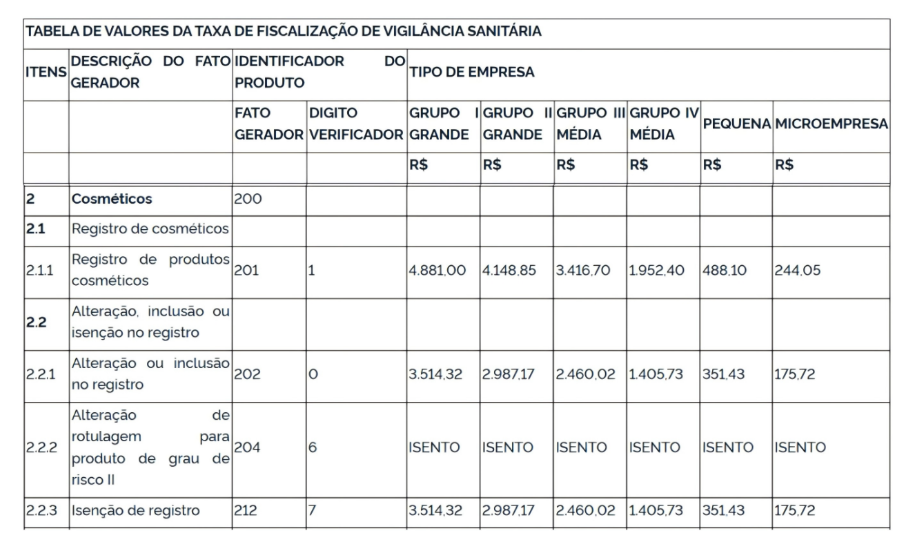
3.Official Fees (denominated in Brazilian Real, R$)
ANVISA charges the Taxa de Fiscalização de Vigilância Sanitária (TFVS) for cosmetic registration and notification services, with fee rates differentiated by enterprise size classification:For cosmetic product registration (Grade II): The fee ranges from R$$ 244.05 for micro-enterprises to $$ 4,881.00 for large enterprises (Group I), determined by the company’s official scale classification.For registration amendment, addition or exemption: The fee ranges from R$$ 175.72 for micro-enterprises to $$ 3,514.32 for large enterprises (Group I).Label amendment for Grade II products: Exempt from official fees.Fees are tiered based on enterprise scale categories: Large Enterprises, Medium Enterprises, Group Enterprises (Tier 1), Group Enterprises (Tier 2), Small Enterprises and Micro-enterprises.Initial Cosmetic Product Registration:Large Enterprises: R$ 4,881.00Medium Enterprises: R$ 4,148.85Group Enterprises (Tier 1): R$ 3,416.70Group Enterprises (Tier 2): R$ 1,952.40Small Enterprises: R$ 488.10Micro-enterprises: R$ 244.05Registration Information Amendment / New Addition Application:Large Enterprises: R$ 3,514.32Medium Enterprises: R$ 2,987.17Group Enterprises (Tier 1): R$ 2,460.02Group Enterprises (Tier 2): R$ 1,405.73Small Enterprises: R$ 351.43Micro-enterprises: R$ 175.72Label Modification for Grade II High-Risk Cosmetic Products:This service is free of charge for all enterprise categories, with no official fee applicable.Registration Exemption Application:Large Enterprises: R$ 3,514.32Medium Enterprises: R$ 2,987.17Group Enterprises (Tier 1): R$ 2,460.02Group Enterprises (Tier 2): R$ 1,405.73Small Enterprises: R$ 351.43Micro-enterprises: R$ 175.72