Brazilian ANVISA Administration Information Abstract

The Brazilian Health Regulatory Agency (ANVISA, Agência Nacional de Vigilância Sanitária) is an autonomous agency affiliated with the Ministry of Health. It is part of the Brazilian Unified Health System (SUS) and serves as the coordinator of the Brazilian Health Regulatory System (SNVS), with a nationwide presence. ANVISA’s role is to promote the protection of public health by exercising sanitary control over the production, sale, and use of products and services subject to health regulation, including related environments, processes, ingredients, and technologies, as well as controls at ports, airports, and borders.
ANVISA official website: https://www.gov.br/anvisa/en
Database link: https://consultas.anvisa.gov.br/#/saude/
Administrative Regulation
• Medical Devices: Resolution RDC 185/2001 and RDC 40/2015
• Materials for health use: Resolution RDC 185/2001 and RDC 40/2015
• Orthopedic Implants: Resolution RDC 185/2001
• In vitro diagnostics: Resolution RDC 36/2015
• Clinical Trials :The regulation that normalizes the submission of clinical trials with Medical Devices to ANVISA’s approval is the Resolution RDC 10/2015
Licensee Requirements
A Brazilian licensee must meet at least the following requirements:
- Be a legally registered company in Brazil;
- Hold an AFE (Pre-Market Authorization) appropriate for the business activities, particularly for importation, storage, and distribution;
- Have authorization from a legally registered foreign manufacturer;
- Be capable of assuming responsibility for registration, labeling, instructions for use, changes, and post-market obligations;
- Be able to cooperate with ANVISA regarding regulatory oversight, reviews, spot checks, and import clearance.
Risk Level Classification of Medical Device and IVD Products
Anvisa classifies medical devices into four categories: medical devices, sanitary materials, orthopedic implants, and in vitro diagnostics.
Medical devices in Brazil are classified into four categories based on the risk they pose to the human body.
The latest Brazilian regulation is RDC 751/2022, which took effect on March 1, 2023. The new regulation aligns more closely with the European Union, including definitions of medical devices and classification rules. Medical devices also follow 22 classification rules, which are largely similar to the 22 rules outlined in the European Medical Devices Directive (MDD) 93/42/EEC.
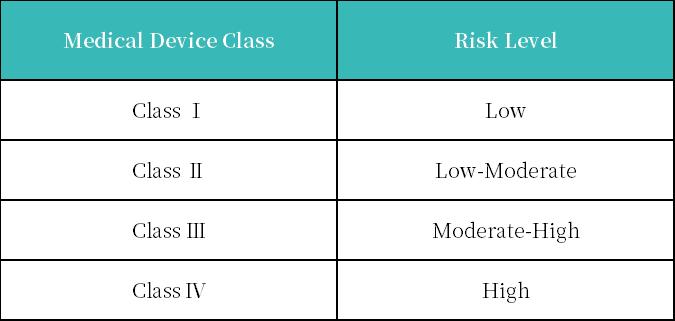
Requirements for Market Access
Foreign medical device manufacturers without a physical presence in Brazil must designate a Brazilian Registered Holder (BRH). The BRH acts as the liaison between the manufacturer and the Brazilian National Health Surveillance Agency (ANVISA), is responsible for the manufacturer’s medical device registration in Brazil, and is listed on the device registration.
Manufacturers must maintain a BRH as long as they sell medical devices in Brazil.
The Brazilian Registered Holder will be responsible for maintaining the registration throughout its validity period, and the manufacturer and its designated distributors will have exclusive use of this record and services.
Registration Language
English + Portuguese
Registration Flow, Cycle & Official Fee
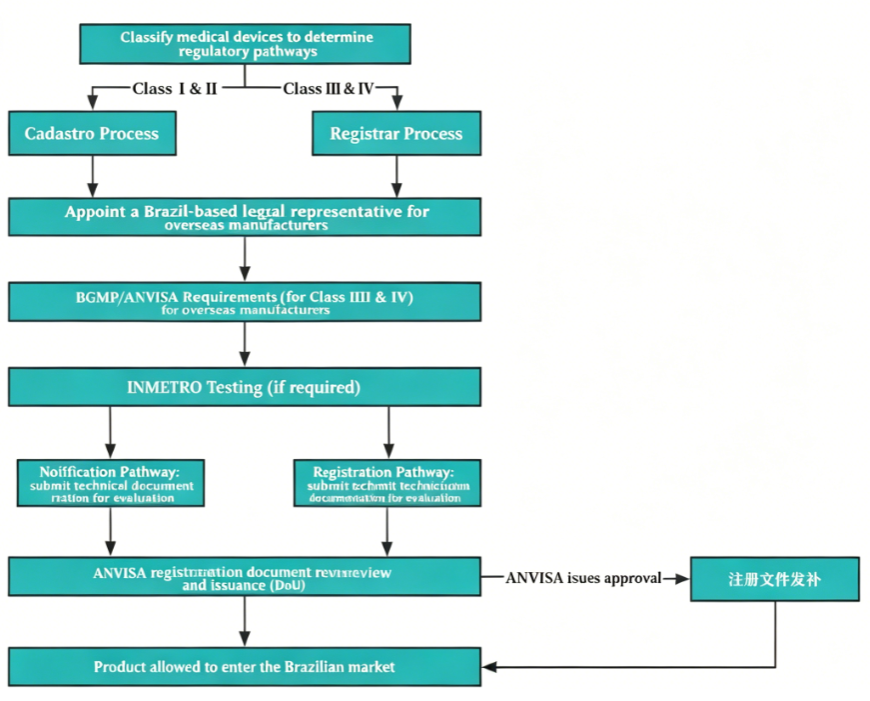
1. Registration Flow
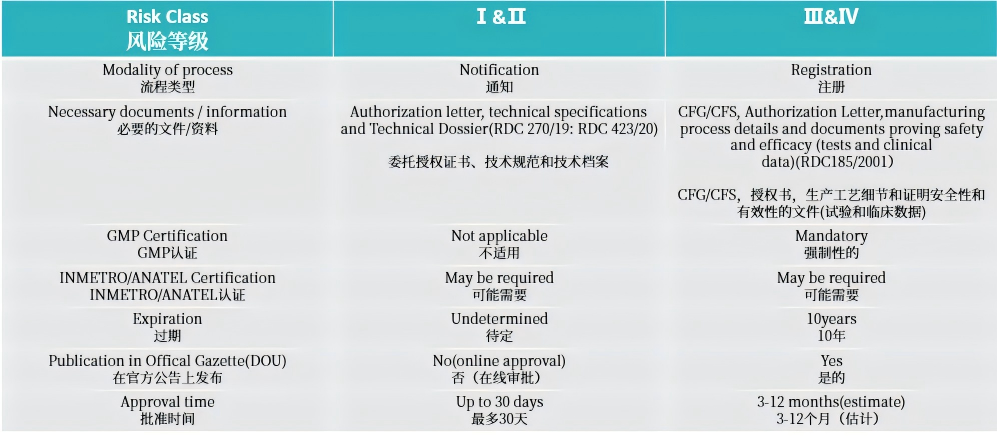
2. Registration Approach
3. Registration Cycle and Official Fee

Product Registration Official Fees (No Discount)
| Risk Class | Service Type | Full Standard Fee (BRL) | Remarks |
|---|
| Class I / II | Simplified Notification (Notificação) | 1,406 | Single product / single model group; perpetual validity with no expiry date |
| Class III / IV | Standard Family Registration | 8,510 | Limited‑model combinations under the same technical platform |
| Class III / IV | Large Multi‑model Family Registration | 19,856 | Numerous derivative models and multiple specifications within the same product category |
三、FAQ
Q: How many opportunities are provided for supplementary information?
A: The medical device registration process is subject to procedural evaluation, reevaluation, audit, market supervision and inspection. If any inconsistency is found or additional information is required, the holder shall adjust it within 30 days; Corrections to previously submitted information are subject to a specific request; Failure to respond to the adjustment notice within 30 days may result in cancellation of registration.
Q: What are the requirements for BRH?
A: All manufacturers that do not have a physical office in Brazil must appoint a Brazilian agent as BRH, as only Brazilian companies can apply for product registration, and the certificate is held by BRH. BRH can be a business partner of the company in Brazil, a branch of the company in Brazil, or a consulting agency with a branch in Brazil. BRH must hold the qualification of business license AFE (Autorizacao de Funcionamento).
Q: Is it mandatory to register a medical device in ANVISA requiring the registration certificate of country of origin?
A: Registration certificate of country of origin is not required.
Q: Is it possible to speed up registration if having a GHTF record?
A: If there is approval from the European Union, the United States, Japan, Australia and Canada, it can influence the audit process of the Brazilian authorities.
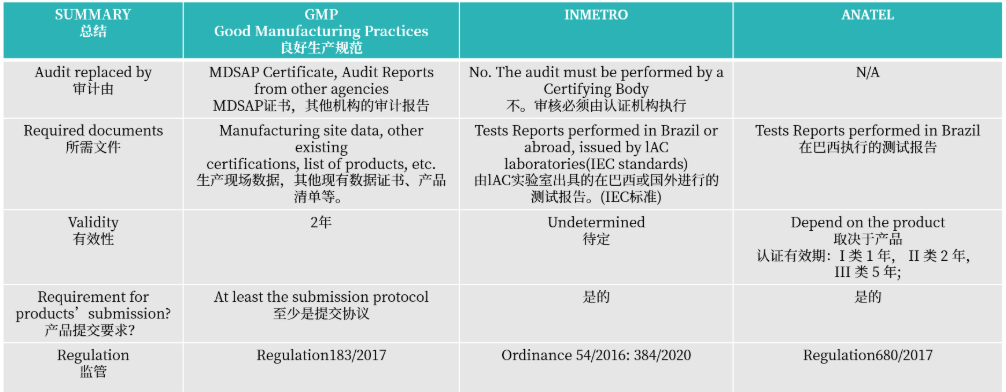
Q: If the manufacturer has the MDSAP system certificate, does it still require to apply for BGMP?
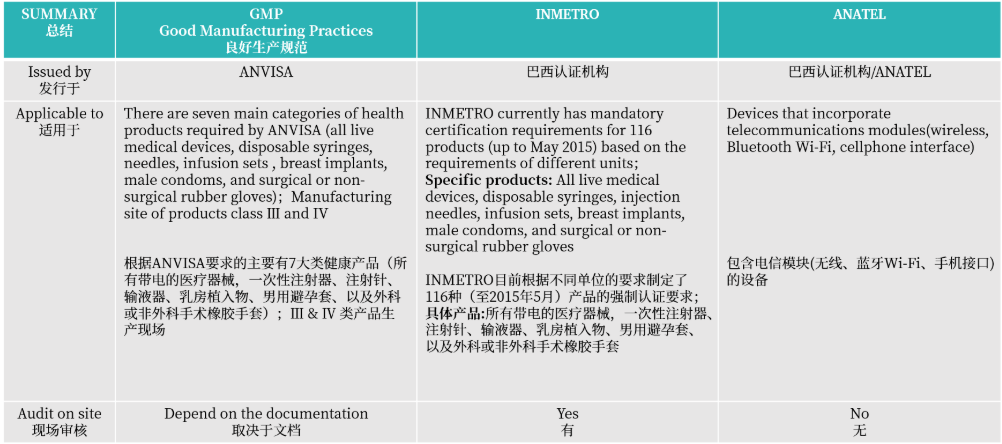
A: Manufacturers must obtain Brazilian Good Manufacturing Practice (BGMP) certification prior to product registration for Class III and Class IV medical devices. The MDSAP certificate is only a good reference for accelerating GMP certification approval, but it does not replace it. If there is a MDSAP certificate, only the document audit can be carried out, which is most likely to eliminate the BGMP on-site audit.
Q: What is INMETRO certification?
A: Certification of electronic medical devices by the National Institute for Metrology, Standardization and Industrial Quality (INMETRO). The certificate is valid for no validity period and INMETRO certification is carried out by a product certification body or OCP (e.g. SGS, TUV Rheinland, UL). As with medical device registration, INMETRO certification requires a licensed BRH, and foreign manufacturers cannot obtain INMETRO certification on their own without a local representative in Brazil. As part of the registration of medical devices, all applicable products must provide a notarized copy of their INMETRO certificate with the registration application.
Q: Is the certificate of registration transferable?
A: In accordance with RDC Resolution 102/2016, transfer of ownership will be considered a new registration procedure.
Q: How long is the Brazilian registration certificate valid?
A: Class I & II permanently valid; Class III & IV is valid for 10 years.