





































Database link: https://www.hsa.gov.sg/medical-devices/e-services
HSA risk classification tool official website:https://www.hsa.gov.sg/medical-devices/registration/risk-classification
ASEAN Medical Device Directive (AMDD)
Medical Device Regulatory Hub:https://www.hsa.gov.sg/medical-devices/


English.
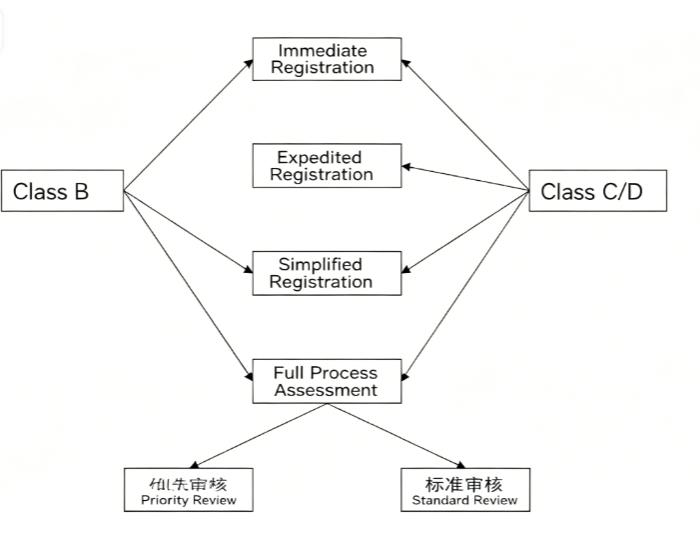
Note: Class A is exempt from product registration, but manufacturing/importing Class A requires submission of Class A product notification; only Class B/C/D require product registration.

Class A requires filing‑only, no product registration fee; Class B/C/D require product registration. Each registration is charged a flat application fee of 560 SGD plus corresponding review fee. All fees exclude third‑party testing and system certification costs.
Review route fees for each risk class (excluding the 560 application fee, charged additionally)
1.Class B Low‑to‑Moderate Risk Medical Devices| Review Route | Review Fee (SGD) | Review Timeline (Working Days) | Eligibility |
|---|---|---|---|
| Immediate | 1,000 | Instant outcome | Holding multiple authoritative overseas approvals; extremely low‑risk Class B devices |
| Abridged | 2,010 | 100 | Holding approval document from one reference country |
| Full | 3,900 | 160 | No overseas approvals; brand‑new Class B devices |
| Priority R1 | 4,420 | 104 | Accelerated pathway; special qualification required |
2.Class C Medium‑to‑High Risk Medical Devices
| Review Route | Review Fee (SGD) | Review Timeline (Working Days) | Eligibility |
|---|---|---|---|
| Expedited | 3,340 | 120 | Hold approval from at least one reference country |
| Abridged | 3,900 | 160 | Have overseas approvals but do not meet expedited criteria |
| Full | 6,250 | 220 | Brand‑new devices without overseas approvals |
| Priority R1 | 7,000 | 143 | Accelerated review pathway |
| Priority R2 | 9,000 | 143 | Highest‑level priority pathway |
3.Class D Extremely High‑Risk Devices (Implantable / Active Implantable)
| Review Route | Review Fee (SGD) | Review Timeline (Working Days) | Eligibility |
|---|---|---|---|
| Expedited | 5,930 | 180 | Hold approvals from 2 or more authoritative countries |
| Abridged | 6,250 | 220 | Only one overseas approval document available |
| Full | 12,000 | 310 | Brand‑new devices without overseas approvals |
| Priority R1 | 13,600 | 202 | Accelerated full review |
| Priority R2 | 17,500 | 202 | Top‑tier priority review |
| Combination Drug‑Device Class D (Full) | 75,600 | 310 | High‑risk drug‑device combination products |
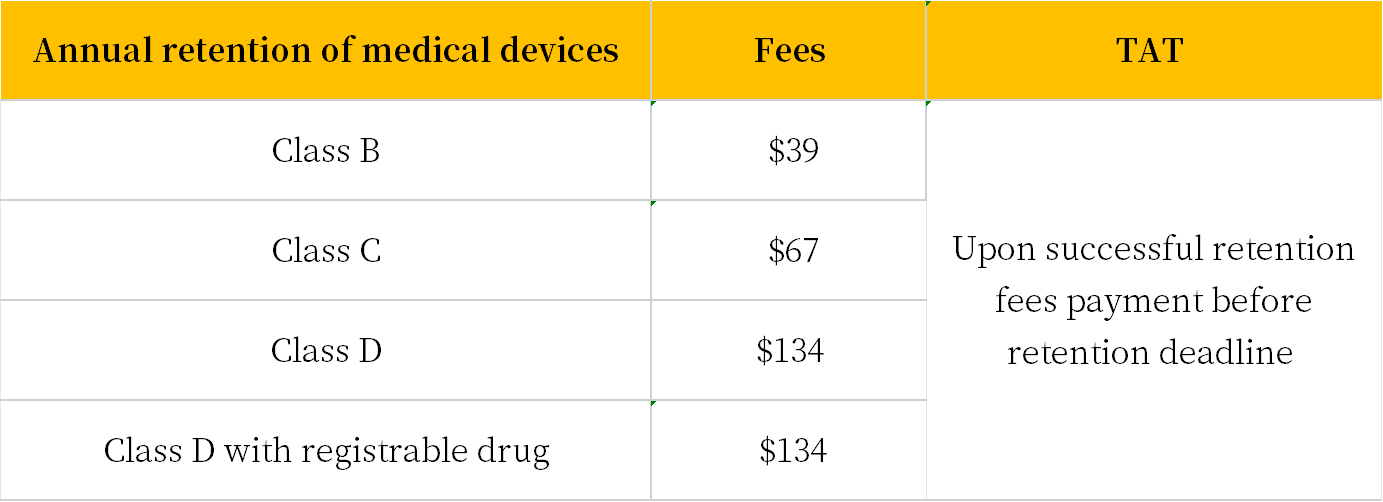
Annual retention in the Singapore Medical Device Register (SMDR)
Change of registrant

A: Sure. If there is a significant change to a medical device product, a change request needs to be filed with the HSA.
A: HSA recognizes the ISO13485 certificate issued by a specific institution at the time of registration of medical devices. Wiselink recommends ISO13485 certificate issued by IAF member organizations according to project experience.
A: Importer information is not required to be submitted during the product registration process, however, importer information is required to be provided and uploaded into the system by the Singapore licensee prior to the sale of the product.
A: Sure.
A: Sure. The Health Products Act 2007 provides for the transfer of registrants in relation to a valid listing. Provide Registrant changes in the GN-24 Guidance on the Change of Registrant.
