











The Health Canada (HC) is the regulatory authority responsible for the safety, quality control and alerting of medical devices. Health Canada regulates medical devices in accordance with the Food and Drugs Act and the Medical Devices Regulations (SOR/98-282). This regulatory process ensures that medical devices sold in Canada are safe, effective and of high quality.
Regulatory Agency's official website link:https://www.canada.ca/en/health-canada.html
Database link: https://health-products.canada.ca/mdall-limh/?lang=eng
As of January 1, 2019, the CAN/CSA-ISO 13485:2016:03 and CAN/CSA-ISO 13485:2016:16 certificates issued by CMDCAS (Canadian Medical Device Evaluation System) are no longer accepted. Therefore, all manufacturers of Class II, Class III and Class IV devices must switch to the Medical Device Single Audit Program (MDSAP) in order to obtain the ISO 13485:2016 certificate after successful audit by an accredited MDSAP audit organization (refer to CAN/CSA-ISO 13485:2016:16, see amendment SOR 2019-44, s.2).
Medical Device Classification, Medical Device Licensing Application, Regulatory Procedures and Fees, as well as other medical device guidance documents and regulatory requirements:https://www.canada.ca/en/health-canada/services/drugs-health-products/medical-devices/application-information/guidance-documents.html

Examples of categories:

MDEL application flow:

MDL application flow:


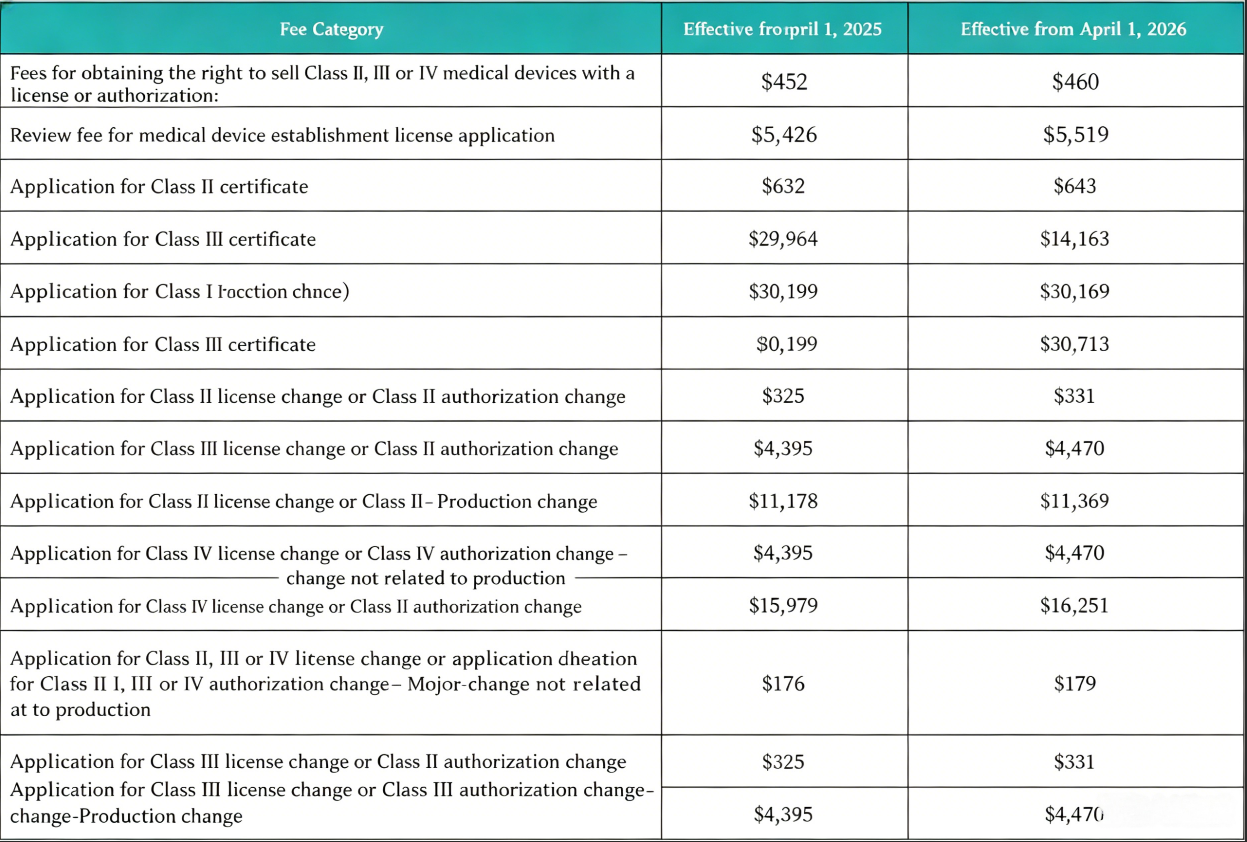
Official MDL Application Fee:
Chapter 3 FAQ
Q: Is it necessary to apply MDL for Class I devices?
A: No.
Q: Heard that Canada recognizes the United States FDA, as long as obtained FDA certificate can enter the Canadian market?
A: The FDA and HC released an initial testing plan, sharing a system eStar to submit device registration applications.
eStar is an interactive PDF form template developed by the FDA. The FDA requires all 510k applications to be submitted using the eStar system starting from 10.1. HC is currently in a pilot phase for eStar (10 companies are already involved in testing).
There is no FDA/HC mutual recognition mechanism. Even if there is eStar, they are audited separately.
Q: How long is the MDL certificate valid?
A: The MDL certificate does not have an expiration date, and Health Canada will send the application for certificate renewal to the manufacturer by mail between August 1 and September 1 each year. The annual maintenance fee must be paid before November 1st each year, otherwise the certificate will be cancelled.
Q: What are the requirements of the QMS system in Canada?
A: HC only accepts quality system certificates issued by a special third-party audit organization known as the Canadian Medical Device Conformity Assessment System (CMDCAS) recognized registry. The Medical Device Regulations do not require importers or distributors of medical devices to have a registered quality system.
The Medical Device Management Regulations require Class II, III, and IV medical devices to be manufactured (Class II) or designed and manufactured (Class III and IV) in accordance with CAN/CSA ISO 13485:2003.
There are no quality system requirements for Class I medical devices

Q: What are the MDSAP licensing organizations recognized by Health Canada?
A: Wiselink has organized the following for you:

Q: If a manufacturer outside Canada has applied for MDEL, do importers in Canada still need to apply for MDEL?
A: Yes. Canada defines an importer as a person other than the manufacturer of a medical device who is located in Canada and is responsible for bringing a medical device into Canada for sale. Importers in Canada must apply for an MDEL license when importing medical devices.
Q: Can Chinese manufacturers act as Canadian importers?
A: No. Canada defines an importer as a person other than a manufacturer of a medical device who is located in Canada.
Q: Once MDEL is registered, do we have to pay an annual fee every year?
A: Yes. After obtaining an MDEL license in Canada, an annual fee is required to maintain the validity of the license.
Q: Is it necessary to have European representative or American representative for registration in Canada?
A: No. Canada does not have an Authorized Representative system similar to the European Union.
Q: What are the small business requirements for the MDL fee waiver for small business qualification?
A: A small business is defined as any business (including all its subsidiaries) with less than 100 employees or annual gross revenue between RMB 155,000 and RMB 25.84 million. Manufacturers who meet this definition are eligible for: a 50% discount on all MDL applications, a one-time fee waiver for the first time you file. Even if the manufacturer withdraws the application before HC makes a final decision, or does not receive a decision from HC, the application is considered a first-time submission and HC will not audit future free applications.