





































Cosmetic products in Taiwan, China are under the unified regulation of the Taiwan Food and Drug Administration (TFDA) under the Ministry of Health and Welfare. Its core responsibilities include market access approval for cosmetics, sales supervision, post-marketing compliance inspections and law enforcement.
Official Website of the Regulatory Authority: https://www.fda.gov.tw/TC/index.aspx
Cosmetic Hygiene and Safety Management Act
Regulations Governing Cosmetic Product Information Files
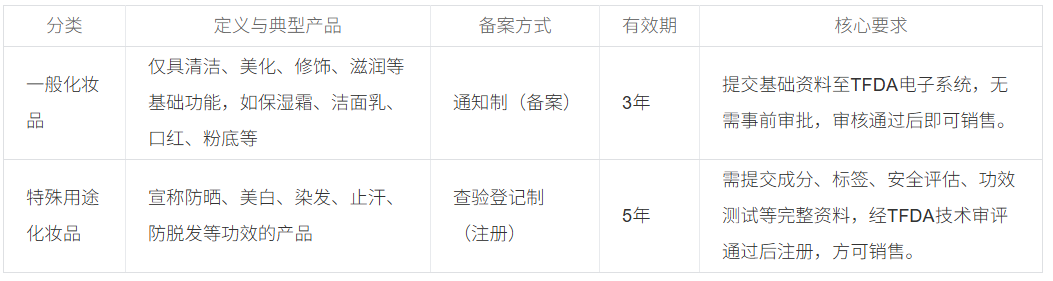
Cosmetic products in Taiwan, China fall into two regulatory categories, with detailed requirements specified as follows:
1.General Cosmetics
Definition and typical products: Products that only perform basic functions including cleansing, beautifying, appearance modifying and moisturizing. Typical products cover moisturizing creams, facial cleansers, lipsticks, foundations and so on.
Filing mechanism: Notification system (post-market filing)
Validity period: 3 years
Core regulatory requirements: Basic product documentation shall be submitted to the electronic system of the Taiwan Food and Drug Administration (TFDA). No pre-market approval is required, and products are allowed to be marketed once they pass the official review.
2.Special Purpose Cosmetics
Definition and typical products: Products claimed to have specific efficacies such as sun protection, whitening, hair dyeing, antiperspirant effect and anti-hair loss.
Filing mechanism: Inspection and registration system (pre-market registration)
Validity period: 5 years
Core regulatory requirements: Complete application materials including ingredient specifications, labeling documents, safety assessment reports and efficacy test data shall be submitted. Products can only be placed on the market after passing the technical evaluation conducted by the TFDA and obtaining formal registration approval.
A cosmetic product refers to a preparation intended to be applied to the external parts of the human body, teeth or oral mucosa, for the purposes of moisturizing the hair and skin, enhancing olfactory perception, improving body odor, modifying appearance or cleansing the body. This definition excludes products classified as pharmaceuticals under other applicable laws and regulations.
① Cosmetic quality system certification (certificates issued by the competent authorities of the country of manufacture are given priority recognition; if official certificates are unavailable, certificates issued by third-party institutions with IAF accreditation are acceptable).
② Complete manufacturer information consistent with the details specified in the quality system certificate.
③ Complete product ingredient formulation list.
④ Documentation related to product labels, packaging, containers and dosage forms.
Traditional Chinese or English
1.Basic Entity Documentation
(1)Qualification of the local responsible person
Business license of the Taiwan-based enterprise, identity document of the legal representative
Letter of authorization for the responsible person (signed by the overseas brand owner, explicitly specifying the entrustment relationship)
(2)Qualification of overseas manufacturing enterprises
Name and registered address of the manufacturer
Manufacturing license (compliant with the regulations of the country of origin)
Quality management system certification of the manufacturer (e.g. ISO 22716)
2.Core Product Documentation
(1)Product information
Product name (in Traditional Chinese), specification and model, country of origin, production date and shelf life
Complete formulation list (including INCI names of all ingredients and their percentage concentrations, sorted in descending order of content)
(2)Safety and inspection documentation
Product safety assessment report (covering raw material safety assessment, formulation risk assessment, and consumer use risk evaluation)
Inspection report issued by a designated testing institution in Taiwan (covering 9 indicators including heavy metals, microorganisms and prohibited ingredients)
(3)Label and packaging documentation
Draft product label (presented in Traditional Chinese, including product name, functions, instructions for use, net content, ingredient list, precautions, and information of the responsible person)
Packaging structure diagram and draft instruction leaflet (in Traditional Chinese, including usage methods and precautions)
3.Supplementary Documentation for Special Purpose Cosmetics
For products classified as special purpose cosmetics (such as sunscreen or whitening products), the following additional documents shall be submitted:
Efficacy evaluation report (supported by laboratory test data or human trial data)
Toxicological report on ingredient safety (e.g. skin irritation test data for sunscreen agents)
Product stability test report (supported by accelerated test data)
1.Registration Flowchart
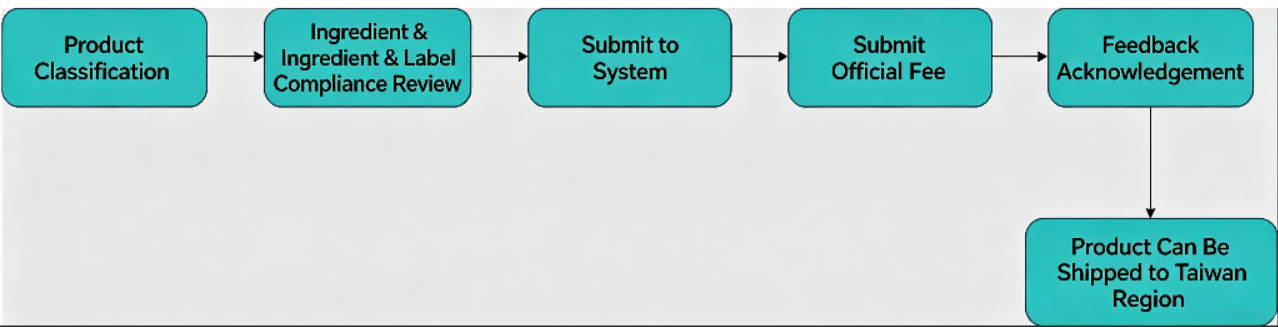
2.Registration Timeline and Official Fees
Official review period: Generally 1 to 2 working weeks. The specific processing duration is subject to factors such as product ingredients and intended use.
Official product registration fee: NT$600 per product. An additional official fee will be charged for modifications to product information, with the specific amount determined by the nature of the change.