





























Turkey: The Golden Eurasian Gateway – Practical Guide to Medical Device Registration
Views:25
Time:2026-07-13 11:33:13
图片

Turkey spans Europe and Asia, boasting robust procurement demand from public and private hospitals, making it a core gateway for Chinese medical device manufacturers expanding into the Middle East and Europe. Many enterprises mistakenly believe a European CE certificate alone allows direct market entry in Turkey, yet two critical access barriers exist. Combining Turkey’s 2026 medical device regulation TMDr, this article fully breaks down the registration workflow to help domestic manufacturers access the Turkish market end-to-end.


一、Regulatory Framework


(一)Competent Authorities & Core Legislation
TITCK (Turkish Medicines and Medical Devices Agency):Responsible for medical device registration, ÜTS product traceability, post-market surveillance and UDI system administration, with functions aligned to the European EMA.
SGK (Social Security Institution):Independently administers SUT Code reimbursement eligibility. Valid SUT Code matching is mandatory for procurement and insurance settlement at all public medical facilities.
Domestic Regulation TMDr:Officially enacted in 2021, fully harmonized with EU MDR 2017/745 and IVDR 2017/746, with transitional grace periods set in place.
(二) Critical Transitional Deadlines
MDR Transition Timeline:
31 December 2027:Class III devices & Class IIb implantable devices (excluding suture wires, bone screws, dental fillers and other exempt products)
31 December 2028 Non-implantable Class IIb devices, Class IIa devices, sterile/measuring Class I devices, plus Class I reusable surgical instruments that do not require NB certification under MDD but mandate NB assessment under MDR
IVDR Transition Timeline:
Class D IVDs:31 December 2027
Class C IVDs:31 December 2028
Class B & sterile Class A IVDs:31 December 2029

(三) Product Risk Classification (Fully Aligned with EU Rules)
Classification directly determines review duration, registration costs and SUT application complexity.
Medical Devices

Class I (Low Risk): Stethoscopes, standard bandages, wheelchairs

Class IIa (Medium-Low Risk): Transfusion consumables, dental materials, hearing aids

Class IIb (Medium-High Risk): Ventilators, infusion pumps, X-ray equipment

Class III (High Risk): Cardiac stents, artificial heart valves, implantable neurostimulators

In Vitro Diagnostic (IVD) Products

Tiered into Class A (Low Risk), Class B, Class C and Class D (Highest Risk). High-risk categories face longer review cycles and stringent requirements for clinical data & health economic evaluations.


二、Complete Practical Workflow for TITCK Medical Device Registration


(一)Mandatory Preconditions (All Required Without Exception)

Valid MDR/IVDR CE Certificate

Appointed Turkish Authorized Representative (TAR) – the sole official local liaison

GS1-compliant Unique Device Identification (UDI) system fully established

Full set of registration documents with professional Turkish translations


(二)Standard 7-Step Registration Process

Appoint a Turkish Authorized Representative (TAR) and sign an official power of attorney

TAR registers an enterprise account for the ÜTS product traceability system

Submit the complete registration dossier online via the TITCK portal

Administrative Preliminary Review: Verify document completeness, translation compliance and UDI coding

Technical Evaluation: Audit technical documentation, clinical evaluation reports and ISO 13485 quality management system records

Respond to deficiency letters and pay official registration fees

Upon approval, the product is listed in TITCK’s public database to obtain legal market access qualification

(三Mandatory Document Checklist for Submission

Basic Documents:Standard TITCK application form, manufacturer qualification certificates, TAR power of attorney, Certificate of Free Sale

Compliance Certificates:MDR CE Certificate, ISO 13485 QMS Certificate, Declaration of Conformity (DoC) with Turkish translation

Technical Dossier:Complete technical construction file (STCF), risk analysis, biocompatibility test reports, EMC & electrical safety reports

Labelling Materials:Bilingual Turkish labels and instructions for use, full UDI coding documentation

Post-Market Documents:Vigilance system protocol, adverse event handling procedures, post-market surveillance plan


(四Four Core Responsibilities of the Turkish Authorized Representative (TAR)

Official Communication Liaison: Interface with TITCK to address all inquiries and inspection mandates

Document Archiving: Securely store the full technical dossier in Turkey for a minimum of 10 years

Compliance Liability: Bear legal accountability for the product’s full lifecycle regulatory compliance

Post-Market Oversight: Support market sampling, product recalls and adverse event reporting

(五Mandatory Requirements for the ÜTS System & UDI

ÜTS (Product Traceability System):All medical devices must be registered on this platform; it serves as the foundation for product marketing, traceability and customs clearance.

UDI Coding:Compliant with GS1 international standards. The UDI-DI base code must be finalized prior to registration, while the UDI-PI production code shall be printed on packaging labels.

Mandatory Bilingual Labelling:Turkish text must be featured on all outer packaging and instructions for use. Translations must be issued by medical device specialist agencies; flawed translations will result in outright registration rejection.

三、SUT Code – Insurance Reimbursement Coding


SUT stands for Standart Ürün Tanımı, a dedicated reimbursement product code issued by Turkey’s SGK Social Security Institution. Devices without a valid SUT Code may only be sold to small private clinics, and are barred from public hospital supply and insurance reimbursement – cutting market scale drastically.

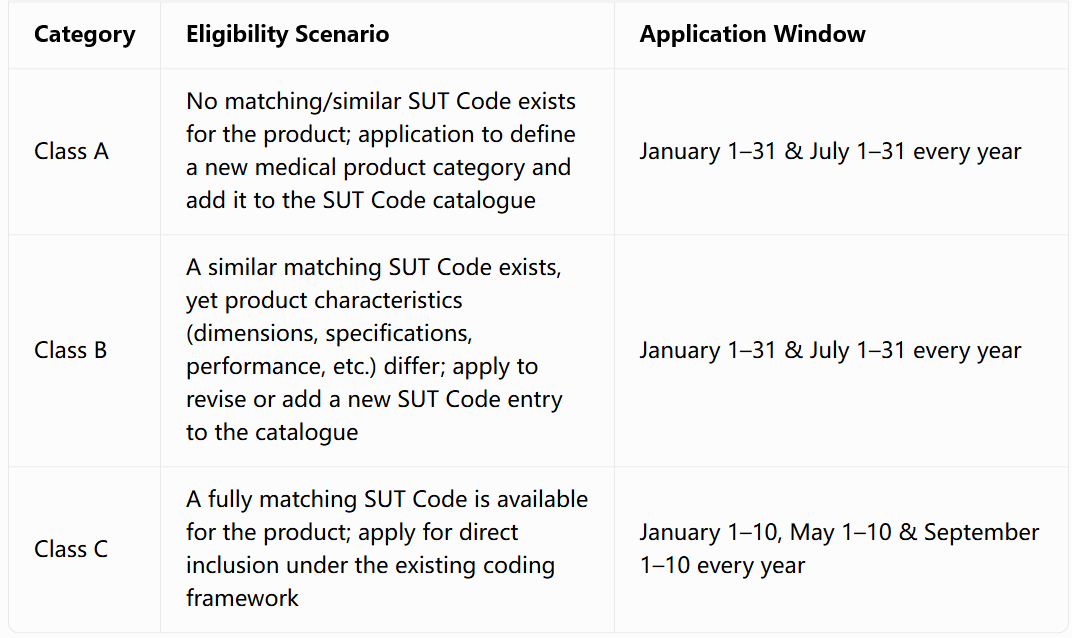
(一)Three SUT Application Pathways
image.pngimage.png

(二)Complete Steps for SUT Code Application
  • Compile the full dossier of TITCK registration, technical, clinical and health economic documents
  • Submit application materials via SGK’s online portal
  • Administrative formal review
  • Technical evaluation of product safety and performance
  • Health economic pricing assessment (core evaluation criterion)
  • Comprehensive deliberation by the review committee
  • Official approval and issuance of the SUT Code
  • Official publication in Turkey’s government gazette, with data integrated into SGK’s Medula insurance settlement system

(三)Key Compliance Risks for Manufacturers
  • Extended Review Timelines: Standard review takes 6–12 months; high-risk innovative devices may require up to 18 months
  • Three Core Evaluation Criteria: Product safety & efficacy, clinical medical necessity, procurement and usage cost-effectiveness (pricing directly determines approval outcome)
  • Mandatory Reporting of Product Changes: Any revisions to specifications, manufacturer identity or pricing must be proactively notified to SGK. Failure to report will suspend reimbursement eligibility and remove the product from the SUT catalogue.
  • UDI & SUT Code Binding Matching: The Medula system automatically cross-references product UDIs; mismatched codes block hospital insurance settlement.


四、Critical Compliance Risk Avoidance Tips


Prioritize MDR CE Renewal to Mitigate Transitional Market Exit Risks:2026–2028 marks the critical transition period between old and new regulations. Enterprises still holding legacy MDD CE certificates must immediately initiate MDR certification upgrades to avoid registration channel closures.
Establish a GS1 UDI System in Advance – Do Not Delay Until Registration:UDI coding is a mandatory threshold for both TITCK registration and SUT Code applications. Non-compliant coding will trigger full application rejection, extending timelines by 3–6 months.
Engage Professional Turkish Medical Translators – Machine Translation Is Not Accepted:CE Certificates, DoCs, IFUs and technical summaries all require official Turkish translations from specialized agencies. Unprofessional terminology triggers repeated deficiency letters and increases audit costs.
Select Specialized Medical Compliance Bodies as Your TAR:The expertise of your local authorized representative directly impacts registration efficiency. General trading firms lack capacity to handle post-market vigilance and on-site TITCK inspections.
Parallelize TITCK Registration & SUT Code Applications to Accelerate Commercialization:TITCK registration alone only grants access to private market sales. To capture the public hospital market segment, launch SUT Code applications concurrently and reserve a minimum 6-month review window in your project timeline.


五、Conclusion


As a member of the EU Customs Union, Turkey maintains steady growth in its healthcare market, with strong demand for cost-effective domestic consumables, imaging equipment and IVD diagnostic reagents. However, market entry operates under a dual-track system of national registration and insurance coding, and regulatory compliance requirements cannot be simplified.For further detailed inquiries, please consult Wiselink Group!


As the largest medical device market with the most sophisticated regulatory framework across Latin America, Brazil serves as the core strategic hub for domestic medical device manufacturers expanding into South America.

To mark the 6th anniversary of Wiselink Group, we are launching a limited-time special offer: from June 18 to July 18, consultation service fees for all medical devices of every risk class targeting the Brazilian market will be discounted by 20%. New and existing clients are warmly welcome to reach out for inquiries!



Contact Us
Fill Form
Whether you need more information or wish to cooperate with us, we will guide you through every step of the regulatory process. Subscribe to our newsletter for the latest global regulatory updates.